




















Gas Spring Calculator
Work out the gas springs you need for a tilt bed, a tilting hood, a hatch or any custom panel on a hinge. Enter what the panel weighs, how far it swings and where the struts will bolt on, and you get the force, stroke and length to go and order — plus a check that the strut will physically fit the space you have.
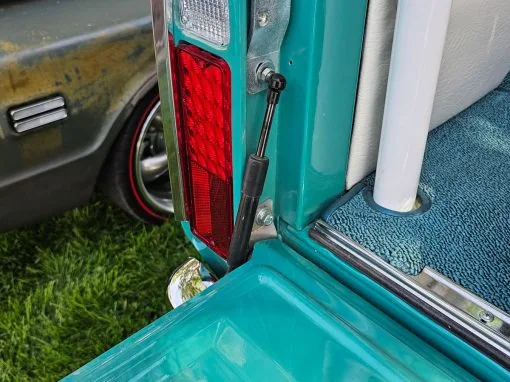
Working on a factory hood? You may not need to calculate anything: our hood strut kits are already sized for the 1947-54 Chevy and GMC, the 73-87 Squarebody, the 88-98 OBS and the 99-06 NBS.
You need four measurements and a weight. The diagram under Mounting points shows exactly where each one is taken from.
The panel
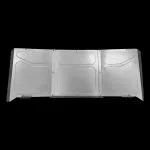
The bed floor, hood or hatch the struts have to lift.
Mounting points
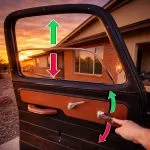
Measure with the panel closed. Every measurement starts at the hinge. Drag a slider to see what moving a bracket does.
-- lb per strut
- Stroke needed
- -- in
- Extended length
- -- in
- Compressed length, no more than
- -- in
- Mount spacing closed
- -- in
- Mount spacing open
- -- in
- Load on each hinge
- -- lb
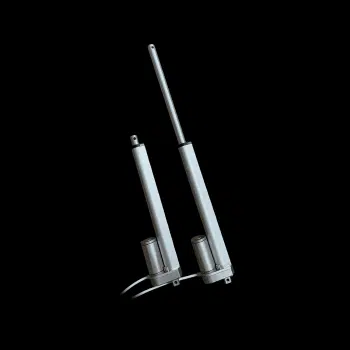
Powered actuators drive the panel rather than balance it, so they are checked against the raw peak load with a 15% margin, not against the gas strut figure above. Confirm the retracted length fits your closed gap before ordering.
Your geometry
Drag the scrubber or hit play to run the panel through its swing.
- Strut length here
- -- in
- At the panel edge
- --
Through the swing
Force at the panel edge across the whole arc. Above the line the struts are carrying it; below the line you are.
Build it with our parts
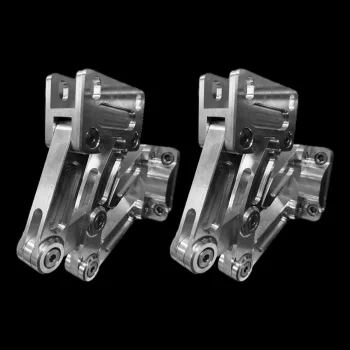
The hinges and lifts this calculator was written for.
Check the numbers before you trust them. This works out the forces for a panel on a fixed hinge from the measurements you enter, and it is only ever as good as those measurements. Scissor and multi-link hinges move their pivot slightly as they open, so treat the result as a starting point. Gas springs also fade with age and in the cold. Never work under a raised bed or hood held up by struts alone — always use a prop.
Getting the weight right
The weight is the number most people guess at, and it is the one that matters most. Weigh the panel on bathroom scales if you can. If it is already built into the truck, put a scale under the free edge, lift until it just breaks contact, and double what the scale reads — the hinge carries the other half.
Include everything that lifts with it: the floor, the frame under it, the bedsides if they are attached, and anything bolted to the top.
Buying the struts
Gas springs are sold by force and by two lengths — extended and stroke. Match the force first, then check the extended length is long enough to reach at full open and the compressed length is short enough to fit when it is shut. The calculator gives you all three numbers plus the mount spacing to check them against.
Force is quoted in newtons by most suppliers. Switch the toggle at the top to see the figure in newtons.
Mounting
Small changes to where the brackets go make big changes to the force needed — moving the panel-side mount an inch closer to the hinge can add a third to the load. Try a few positions in the calculator before you weld anything, and watch the drawing to see the strut clear the structure through the whole swing.
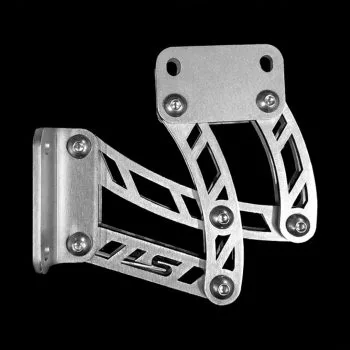
Working on a tilt bed? Our tilt bed scissor hinges and electric tilt bed lifts are built for exactly this job, and the scissor hinge installation tips and tricks guide walks through a real install.