
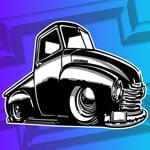
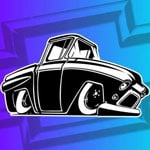
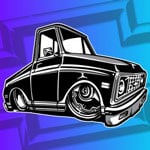
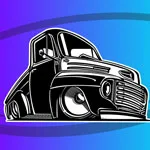
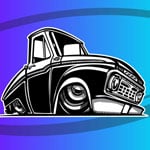
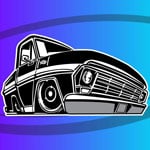
If you own a 1955 Chevy truck, the first thing anyone selling you parts will ask is “first series or second series?” In 1955 Chevrolet built two completely different pickups. The first half of the year was the old Advance Design truck, carried over from 1954. From March 25, 1955, the all-new Task Force truck took its place. Both are titled as 1955s, and almost none of their body parts interchange.
Here’s how to tell which one you have, what changed, and which parts fit each.
Why 1955 has two series
Chevrolet’s new 1955 cars, with the first Chevy small-block V8, launched in the fall of 1954 and took up most of the advertising budget. GM staggered the launch, so dealers kept selling the Advance Design pickup, lightly updated, as the 1955 “first series.” The new Task Force trucks followed in spring 1955 and went on sale as the 1955 “second series.” GMC did the same thing with its own trucks, so a 1955 Chevy truck and a 1955 GMC share the same split.
1955 first series vs second series at a glance
| 1955 first series | 1955 second series | |
|---|---|---|
| Generation | Advance Design (1947–55) | Task Force (1955–59) |
| Built | Late 1954 to March 1955 | March 25, 1955 onward |
| Windshield | One-piece curved glass, same as 1954 | Wraparound “panoramic” windshield |
| Front end | 1954-style “bull nose” grille with a crossbar | New egg-crate grille, headlights hooded in the fenders |
| Cab | Rounded Advance Design cab, five-window option | Squarer, lower cab with a new dash and centred gauges |
| Engine | 235 six-cylinder | 235 six, or the new 265 V8 as an option |
| Electrical | 6-volt | 12-volt |
| Driveline | Open driveshaft, new for 1955 | Open driveshaft |
| Special models | None | Cameo Carrier with fiberglass bed panels |
How to tell which 1955 you have
- Look at the windshield. If the glass wraps around the corners of the cab, it’s a second series. A flat-sided, one-piece curved windshield means a first series. This is the fastest check and it works from across a parking lot.
- Look at the front fenders. First series trucks have the rounded Advance Design fenders with the headlights set into them. Second series fenders are flatter and wider, with a hood over each headlight.
- Check the electrical system. A factory 6-volt truck is a first series. A factory 12-volt truck is a second series. This one is less reliable on its own, because many first series trucks have been converted to 12 volts.
- Check the paperwork last. The title says 1955 for both series, so it can’t settle the question by itself. The body can.
If a seller swears a truck with the wraparound windshield is “an early ’55,” trust the windshield. For body, cab and interior parts, the body on the truck is what decides what fits.
The serial number settles it too. A second series serial has a 2 straight after the series letter (H255…), and a first series serial doesn’t (H55…). Our Chevy truck VIN decoder reads both.
What changed on the 1955 first series
The 1955 first series is almost a 1954 with two useful changes. The torque-tube driveline was replaced by an open driveshaft, which is easier to work on and makes rear axle swaps simpler. The hood emblems were also updated. Everything else, including the cab, windshield, grille and 235 engine, carried over. For a closer look at the whole 1947–55 run, see our Chevy 3100 guide.
What was new on the 1955 second series
The Task Force trucks were a clean-sheet design. Beyond the wraparound windshield and new sheet metal, the second series brought a 12-volt electrical system, a new dash, and for the first time in a Chevy pickup, an optional V8: the 265 cubic inch small block. It also introduced the Cameo Carrier, a dressed-up half-ton with fiberglass panels on the bed sides and tailgate that is now one of the most collectible trucks of the decade. The half-ton kept the 3100 series number, which is why you’ll see “1955 Chevy truck 3100” used for both series.
Which parts fit your 1955 Chevy truck?
This is where getting the series right matters. Body, cab, interior and most trim parts follow the generation, not the model year:
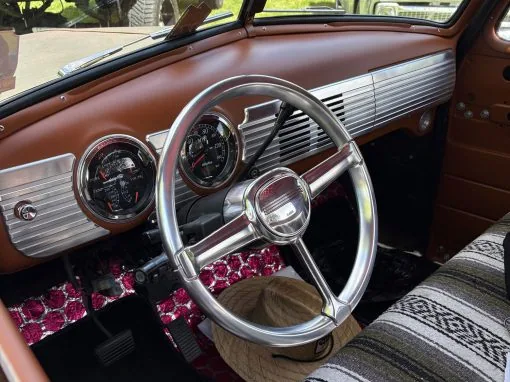
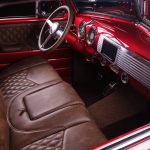
- First series: shop the Advance Design parts. Our 1947–54 Chevy 3100 parts fit the 1955 first series in most cases, including sheet metal like the behind-the-seat panels and the 1947–55 upholstered interior kit. Parts tied to the 1954-style dash and windshield fit; parts for 1947–53 dashes don’t.
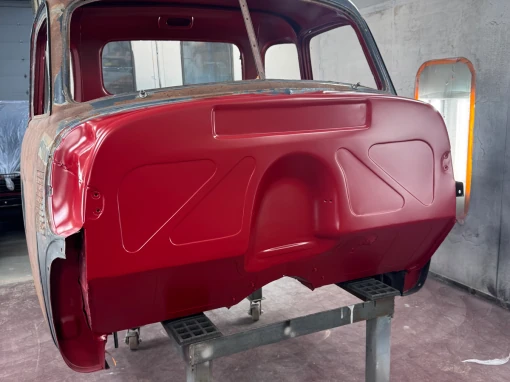
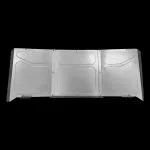
- Second series: shop our Task Force parts section, which include the bead-rolled firewall, radius bed corners and tailgate trunnion kit.
- Not sure yet? Our parts page for the 1955 model year lists parts for both series. Check the fitment notes on each product before you order.
Mechanical parts are a bit different. Engines, brakes and axles weren’t always tied to the body change, and plenty of trucks have been swapped since. For those, go by what’s actually on your 1955 Chevy truck rather than the year on the title.
1955 Chevy truck FAQ
Is a 1955 first series truck a 3100?
If it’s a half-ton, yes. Both the first series and the second series half-tons carry the 3100 series number. The first series is an Advance Design 3100 and the second series is a Task Force 3100.
Did 1955 first series trucks come with a V8?
No. The first series was six-cylinder only, with the 235. The 265 V8 was a second series option.
Did GMC have a first and second series in 1955?
Yes. GMC also sold its older trucks into early 1955 before switching to the new body, and the same windshield check works on a GMC.
0 Comments