
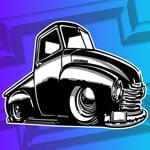
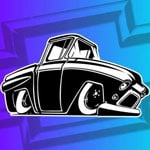
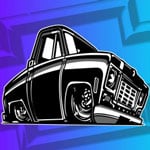
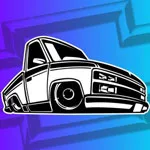



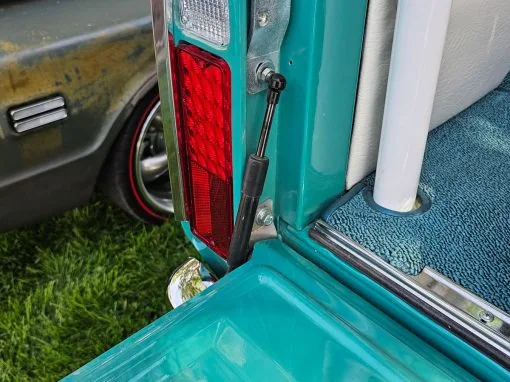
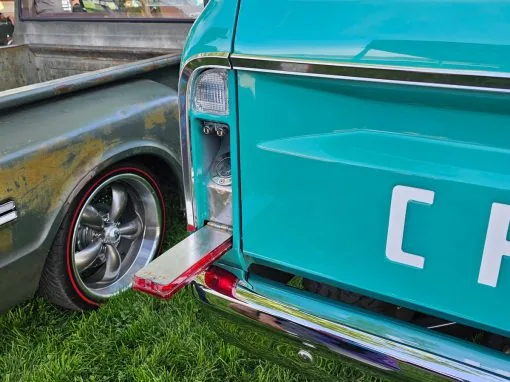
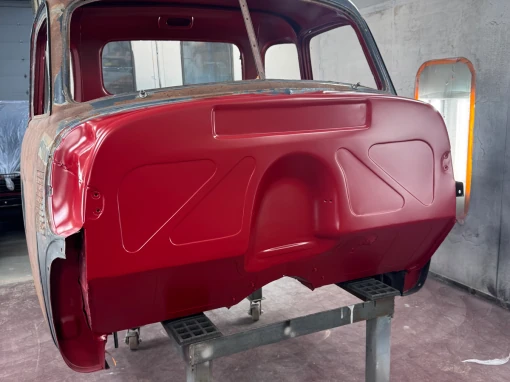
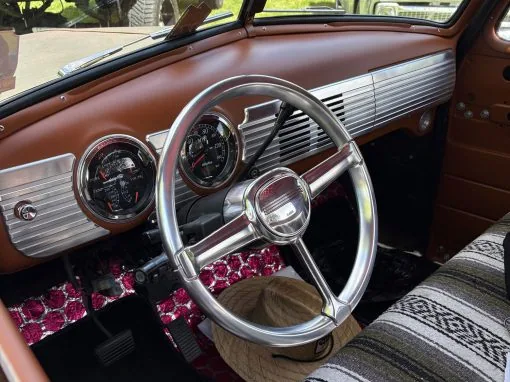

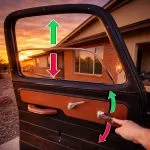
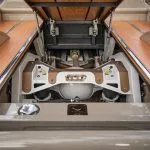
Ask an owner what they drive and you’ll rarely hear “1951 Chevrolet half-ton pickup.” You’ll hear “a ’51 3100.” The Chevy 3100 is the half-ton pickup from Chevrolet’s Advance Design series, built from the summer of 1947 until early 1955. It was GM’s first all-new truck after the Second World War, and it’s still one of the most recognizable pickups ever built.
This guide covers what the 3100 name means, how it relates to the 3600 and 3800, the year-by-year changes that let you date a truck, and what to know before you buy parts for one.
What does 3100 mean?
3100 is Chevrolet’s series number for the half-ton model. The Advance Design trucks were sold in several payload classes, and each had its own number:
| Series | Rating | Typical body |
|---|---|---|
| 3100 | ½-ton | Short-wheelbase pickup, panel, Suburban |
| 3600 | ¾-ton | Longer pickup and stake bed |
| 3800 | 1-ton | Longest pickup, panel and stake bed |
| 4400 and up | Medium duty | Stake, dump and cab-and-chassis trucks |
Because the half-ton was by far the most common, “3100” became shorthand for the whole generation, and people often use it for any 1947–55 Chevy pickup. GMC sold its own version of the same truck with GMC grilles, badges and engines, and most of the cab and body sheet metal is shared between the two.
Advance Design: the 1947–55 generation
Advance Design production started on June 28, 1947, well before Chevrolet’s cars got their post-war redesign. The trucks were bigger, wider and more comfortable than anything Chevrolet had sold before, with a roomier cab that seated three across. The run ended on March 25, 1955, when the Task Force trucks replaced it partway through the year. That’s why 1955 has a “first series” and a “second series,” which we explain in our 1955 first vs second series guide.
Five-window vs standard cab
From 1947, Chevrolet offered a Deluxe Cab option with two extra windows in the rear corners of the cab. Those trucks are what everyone now calls “five-window” 3100s: two door windows, the back glass and the two corner windows. The standard three-window cab has solid rear corners. Five-window trucks are the ones most buyers look for today, and they usually command a premium. Corner glass, seals and the trim around it are specific to the Deluxe Cab.
Chevy 3100 year-by-year changes
Chevrolet made small running changes every year rather than big restyles, so dating an Advance Design truck comes down to details:
| Year | How to spot it |
|---|---|
| 1947 | Introduced mid-year. No door vent windows. Hood side emblems read Thriftmaster (light trucks) or Loadmaster |
| 1948 | Gear shift moves from the floor to the steering column on the three-speed. Foot-operated parking brake |
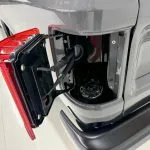
| 1949 | Fuel tank moves from under the bed to behind the seat, filler neck behind the passenger door. Late in the year, hood side emblems switch to the series number (3100, 3600, 3800) |
| 1950 | Tubular shock absorbers replace the old lever-action type. Last year for the driver’s-side cowl vent |
| 1951 | Vent windows added to the doors. Bed wood changes from nine boards to eight partway through the year |
| 1952 | Push-button outside door handles. 90 mph speedometer |
| 1953 | Last year for the 216 six-cylinder. Series number becomes the only hood side emblem |
| 1954 | Biggest update of the run: one-piece curved windshield, new “bull nose” grille with a crossbar, new dash and steering wheel, and the 235 six. Hydra-Matic automatic becomes available |
| 1955 first series | Almost identical to 1954, but with an open driveshaft instead of the enclosed torque tube and revised hood emblems. Built until March 1955 |
The two dates that matter most for parts are 1951, when the doors gained vent windows, and 1954, when the windshield, grille, dash and engine all changed at once. A 1950 3100 and a 1954 3100 look similar from the side, but their door glass, windshield, dash and front end don’t interchange.
If the truck still has its serial plate, our Chevy truck VIN decoder reads the 1947-55 formats and gives you the model year, the series and the plant that built it.
Engines and drivetrain
- 1947–1953: the 216 cubic inch inline six.
- 1954–1955 first series: the larger 235 cubic inch six.
- Electrical: every Chevrolet Advance Design truck left the factory with a 6-volt system. Many have since been converted to 12 volts.
- Driveline: a torque-tube driveline through 1954. The 1955 first series switched to an open driveshaft.
A lot of Chevy 3100s on the road today no longer run the original six at all. Small-block V8 swaps, independent front suspension kits and modern steering are common on street-driven trucks, which is why fitment for some parts depends on how the truck has been built rather than just its year.
Buying a 3100: what to check
- Cab corners and floors. Water sits under the floor mat and behind the seat. Check the floor pans, the toe boards and the panel behind the seat before anything else.
- Door bottoms and hinge pillars. Sagging doors usually mean worn hinges or rust in the pillar.
- The bed. Wood can be replaced easily. Rusted bed sides, cross sills and front bed panels take more work.
- Year-correct parts. Previous owners often mixed years. A 1953 with a 1954 dash, or a 1950 with 1951 doors, is common, so identify the parts on the truck before ordering to match them.
Chevy 3100 parts
We build a lot of our own parts for these trucks: laser-cut and bead-rolled sheet metal, billet pieces and complete interior kits. They’re all in our 1947–54 parts section. Most parts listed for 1947–54 also fit the 1955 first series, but always check the fitment notes on the product page. A few of the parts our customers start with:
- Hood strut kit: replaces the prop rod so the hood stays up by itself.
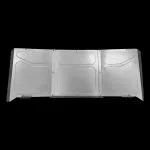
- Bead-rolled behind-the-seat panels and a transmission tunnel for cab rebuilds.
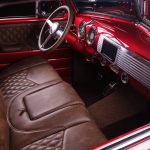
- Upholstered interior kit covering the 1947–55 cab.
- Tucked aluminum radiator for V8-swapped trucks.
Step-by-step installs for many of these are in our 1947–54 installation guides. If you’re shopping for one exact year, the year pages narrow things down, for example 1950 Chevy truck parts or 1954 Chevy truck parts.
Chevy 3100 FAQ
What years is the Chevy 3100?
The Advance Design 3100 was built from mid-1947 to March 1955. Chevrolet kept using the 3100 series number on the Task Force half-ton that followed, from 1955 to 1959, so a “1957 3100” is a Task Force truck, not an Advance Design.
Is a 1954 Chevy 3100 different from a 1953?
Yes, and more than any other year change. The 1954 got the one-piece windshield, a new grille, a new dash and the 235 engine. Parts for those areas are usually sold as 1947–53 or 1954–55.
Do GMC parts fit a Chevy 3100?
Most cab and body sheet metal is shared. Grilles, trim, badges and engines are brand-specific. That’s why our 1947–54 parts are listed for both GMC and Chevy wherever the part is shared.
0 Comments